| Buddy Emmons At E's |
| This is
the second column that Buddy did
for Tom Bradshaw's "Steel Guitarist" magazine. Issue 6 & 7 (Double issue) May 1981 |
| Minor Abrasions In The Pockets |
| In
1974 I moved from Los Angeles to Nashville, intending to bury my C6th
neck, with all it's stale licks, in the Tennessee hills and settle down in
the secluded comfort of the studio. I had great visions of getting
up each morning, piling into the car, and darting off to work. In
short order, however, factors turned me off to that particular life
style. One was having to get up each morning, pile into the car, and
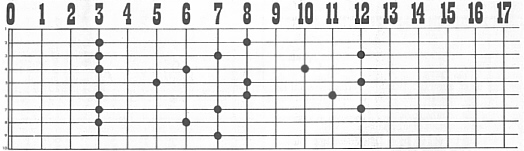
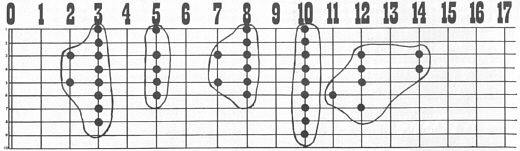
dart off to work. The other was a guitar player named Pat Martino. As I sat in my music room, looking for something to please the producers in the "lick-of-the-month club" downtown, the phone rang. A friend wanted me to hear (over the phone no less!) a cut on an LP he had just gotten. The album title was Pat Martino Live. The tune "The Great Stream," sounded more like a hot bee than anything else. After all, Ma Bell's frequency range is not exactly State of the Art, but I heard enough to ask him to bring it over. He did, we listened, and I had, immediately, a renewed interest in 6th jazz as a bonus. With my rekindled interest I also focused on a major-minor problem I had experienced for years. In plain words, I could not take a decent solo in a minor key. I became interested in a cut on Martino's album called "Sunny" and, gradually, by learning a few licks, discovered the Martino approach to certain minor scales. Below are a set of positions and pockets to use when you battle your way through a solo. They ease some of the minor abrasions you will likely encounter. To begin, the C minor triad is a C major triad with the third note of the C scale flatted a ½ tone. You can discern the difference by first playing strings 5, 6, and 7 in the open position on the C neck, then strings 6, 7, and 8 on the third fret. The tuning is a C6 with a D on top (as in the prior column.) The first diagram shows the C minor triad (C Eb G) in various positions on the neck. Familiarize yourself with the sound and location of these notes. The second diagram has the same notes with the addition of the minor 6th, 7th, and 9th notes in their pockets. As in the last issue, the pockets are just visual positions on the neck to use or tie together to form a solo. One noticeable similarity is that the minor and major notes are much the same, but in different positions on the neck. For example, a diminished chord in one spot can be used as part of a flatted ninth chord in another. The same applies to a minor. In diagram 2, the set of notes on the third fret constitute the minor 6th and the minor 7th chord. These same notes in the major mode apply to the F9th and Eb6th chord. So, in C minor, think F9th, or in G minor, think C9th, and so on. |
| DIAGRAM 1 |
 |
| DIAGRAM 2 |
 |
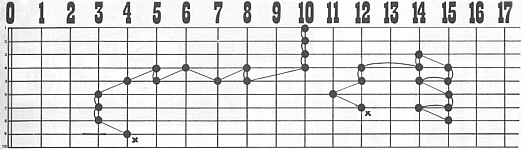
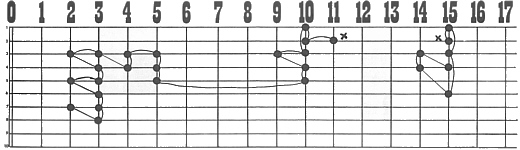
Diagrams
3 and 4 illustrate some of the pockets in the form of scales, along with a
few embellishments. Start on each "X." The 5th and
6th charts present the notes as they might be used in a solo. |
| DIAGRAM 3 |
 |
| DIAGRAM 4 |
 |
| DIAGRAM 5 |
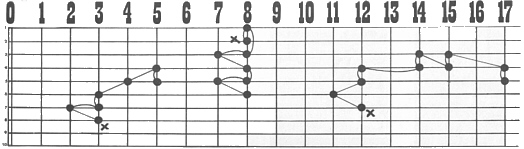 |
| DIAGRAM 6 |
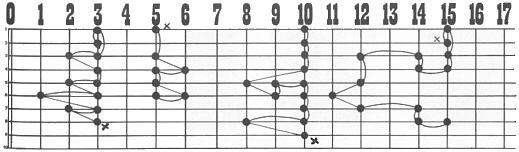 |
©1981 Tom Bradshaw. Used with permission, (from Tom and Buddy). |
