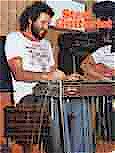
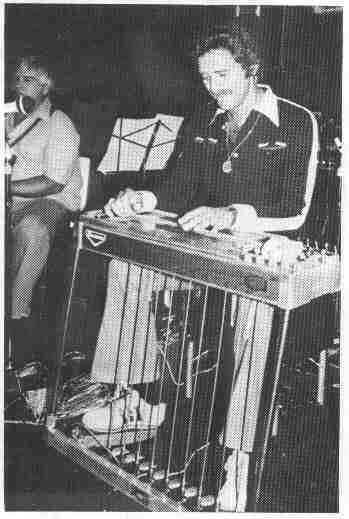
Buddy Emmons Some refer to Buddy Emmons as "The Guru Of The Steel Guitar." This translates as the "Foremost Steel Guitarist." Scotty chose to give Buddy a plaque at the 1977 Steel Guitar Convention with those words on it. For several years prior to that, and even since then, Buddy has maintained the "first chair" position. In his earlier years, he traveled around the U.S. with several groups which allowed many aspiring steel players to view and hear him. At age 20 he recorded "Four Wheel Drive" which was an awesome performance of virtuosity that also dramatically revealed the steel guitar capable of being played with incredible speed. It also gave impetus to the belief that the steel was an instrument for the jazz idiom. (The idea was not new, but insufficient people were aware of it. Few non-steel musicians even cared.) Perhaps more importantly, Buddy displayed a style that was immediately appreciated and universally accepted. Quickly, he gained a flock of idolizers which has grown over the years. Emmons has grown in his musical prowess, whereas his style has remained nearly constant. That may be because he has chosen to expand it, rather than incorporating others' styles into his own. Emmons has been discussed in many journals. He provided a lengthy musical biographical summary on one double-album jacket, ("Steel Guitar Jazz" and "Four Wheel Drive"), so that aspect of his earlier career will not be covered here. Many questions have gone unanswered in prior articles and interviews. He answers many of them now:
Tom: What are your present activities in Nashville and are you satisfied with what you are doing? Buddy: Recording sessions and weekend concerts take up a lot of my time now. Recording offers good money for the time that's spent doing them, but they do become boring after a while. My heart has always been in freedom of expression. Sessions offer freedom up to a point, but that's little consolation for the hundreds of hours I've spent trying to cultivate my playing in the many different forms of music other than country. I think the steel has been stereotyped, and many players have been afraid to venture away from being a good country steel player. I feel that this has been unfortunate, since they not only hold themselves back, but also the instrument. Apart from sessions, I've been working with a jazz group out of Washington D.C. called the "Redneck Jazz Explosion." The leader of the group is a very fine guitar player by the name of Danny Gatton. The drummer is Scott Taylor and the bass man is Steve Wolf. We work at a place in D.C. called the "Cellar Door." Playing with this group has restored my faith in the existence of enough people to make a jazz-appreciating audience. Tom: How do you get your work in Nashville? Buddy: The sessions are always set up through a producer or by the leader of the session. The jobs aren't as unusual as some of the producers are! For example, I was at a session shortly after the movie, "Jaws," was released, and as you know, one of the main functions of a session player is supplying fills for a song, according to the lyrics. I've had a lot of coaching along these lines, but when the producer requested "shark sounds," that stumped me for a while. I thought for a bit, pulled a flanger from my "toy box" and gave him a "swimming-type effect" which got him off my back and onto somebody else. Needless to say, I receive weird requests at sessions. Tom: What kind of work do you like best? Buddy: I like about any kind of job except those that are inconvenient. I've been called for show jobs, such as those put on during the DJ convention, which require rehearsals. These are necessary, but I also hate them. These rehearsals go on and on; perhaps up to one hour before showtime. The rehearsal is typically in one part of town and the show is in another, so I have to pack up and drive to the show, unload, go find a parking place, walk back to the show, hoping someone didn't run off with my equipment. I'd hate to have to find a place to park during a convention if I was just going to listen, let alone play. This ,may sound like I'm a little picky, but I've turned down several jobs just for that reason. I still get inspired when I play. The thing that turns me on the most is when I'm around great musicians. If they know more about what's happening than I do, it makes me work harder and usually results in a much better performance on my part. After all, I've been listening to me play for 31 years and, quite frankly, I bore myself to death with some of my old cliches. Anytime I can surprise myself, it's like a breath of fresh air. Tom: Do other steel players' work influence you? Buddy: I don't listen to other steel players for the purpose of learning licks. I like to hear different approaches and attitudes toward the instrument. If I hear something really interesting, I'll try to interpret it in terms of something beyond what they are doing, or, in other words, something to build on from that point. I think it's good for someone trying to learn more about the steel to look for good licks, but when you get to the point where you can hear and know exactly where the lick is on the neck by listening, then I think you should reach beyond that and build it into something of your own. I don't want to sound like I know everything there is to know, but there is a point where you hear other licks, and you are sufficiently familiar with you own guitar, that you can interpret everything mentally. You don't have to go to your guitar to find what you are hearing or thinking. Tom: Do you listen to other instruments? Buddy: Definitely. I listen to a guitar player by the name of Pat Martino. He plays guitar the way I would want to if I were a jazz guitarist. I listen to many other instruments and scales and so forth, the reason being that those instruments have been around so much longer than the steel, and have been in the hands of so many accomplished players. When you weigh the history of the steel guitar against the piano or the violin or any other instrument that's been around a hundred years or more, you realize there is much more from which to draw in the way of musical interpretation. Tom: What effects devices do you use and do you modify them? Buddy: I always look for new effects to use with the steel. I don't like to lean on them during live performances, although if they are used tastefully, they do serve as a good deterrent to monotony. As far as studio work is concerned, I think that's the launching pad for new styles and sounds, so effects are always in demand. In fact, effects have gotten me many sessions that would not have been available had I been a "pure" steel player. I think producers are recognizing that the sounds the steel is capable of creating with the effects devices is what they want. Effects devices have made the steel more popular and more versatile. Incidentally, I think the steel guitar is the best driver for effects of any instrument I know. I usually see a new gadget in Guitar Player magazine and if it looks interesting, I borrow it from a local music store in Nashville. They let me use it to see if it works well or not. Anything new is important to me and worth considering, and that goes beyond music. I discovered the "boiling bowl" -effect (on "Witches Brew") through experimenting with rhythm sounds on the steel, while using a Echoplex. Actually, it was just a variation of the old "tic-tac" sound that guitarists used on records years ago. The actual bubbling effect was introduced with a wah-wah pedal after establishing the rhythm pattern. I don't modify my equipment, although I'd like to. There are a few pieces of equipment that I would much rather have a particular way than they now are. There is someone I just recently met who has offered to help me with modifications. I'm looking forward to experimenting with a number of devices. Tom: What about your own guitar? Do you alter your pedal set up? Buddy: I always consider new pedal changes, but never have changed my setup for the sake of one session. Tom: What do session leaders expect from you? Buddy: The only thing expected of me or anyone else on a session is combining my ideas with the ideas of a producer and/or the artist. My capabilities are usually known before I'm hired and I'm pretty much left alone, unless there is some definite plan beforehand. I don't have any particular problems in the studio as far as getting along with the producers, or adapting. The players I work with are all good-natured and know the pressures involved and how to cope with them. I've never been fired from a session, but about 15 years ago I walked out of one with Ray Price. It had nothing to do with Ray personally. Someone was showing me the guitar part of a song expecting me to duplicate it on the steel. It was physically impossible. That was back when I was boozed up, I was tired and finally told the man I didn't like the lick, didn't like the song, and would just as soon not play. Jimmy Day was in the studio so I told them to do me and themselves a favor and let Jimmy finish the session-- and they did! I've worked about everything I'm called for with a few exceptions. Tom: What do you view as a "lousy" session? Buddy: It's a session with a singer who breaks meter, and you have to lead them through everything, which allows you very little time for the music itself. However, I remember a Neil Diamond session in California where we would work up the tunes to a certain point and Neil would decide he wanted something else. We'd go that way for awhile and when we were just about finished, he would have us go off in another direction. Then we would spend another hour rebuilding the song. Ordinarily, that is the way to approach material and look for ways to make it a hit, but Neil had a way of doing it that left you mentally exhausted. I call that a lousy session too. In fact, I think I heard that song that we recorded out there and the stinger was that my part was mixed out! I've been called to play lead, rhythm guitar and bass on some sessions, but I certainly don't encourage it. I played bass with another steel player on a session and the only lasting thought I had was how much nicer it was to walk out of the session with a bass under my arm while he was still packing up his steel! Tom: Is there concern about not getting paid for a session? Buddy: I'm rarely concerned about not getting paid in Nashville. Ninety-eight percent of the jobs I get involve someone I know personally or have known of for years. I know whether to accept work by knowing the reputation of the producer. Of course there are always certain risks in dealing with independent producers you don't know, whether he or the artist is paying for it. I have had a few artists skip town on some of these accounts, leaving the producer and everybody holding the bag. Tom: What is the pay and what equipment do you use on sessions? Buddy: Master sessions right now are about $135.00 for three hours (per man). I bring every piece of equipment I have to a session. This includes an MXR phaser and a Blue Box, among other things. The Blue Box gives me the original note, blended with a note two octaves below it. This will also mix either note in or out individually if I need to have the octave below the lead note, by itself, or my high note coming out with a slight fuzz effect to it. I have the MXR fuzzy device which is not all that great by itself, but when used with the Blue Box, it gives a sound somewhat similar to a bassoon, which is a sound not often used at country sessions. Nevertheless, I bring it. Also, I have an MXR envelope filter follower that gives a wah effect just by picking the string. In fact, I use that when I do "Witches Brew" in place of the wah-wah pedal. Then there's an MXR Analog Delay unit that I just got. I use it for slight echo effects. Of course, I have an Echoplex for the long delays which is much cleaner on the echoes, but the Analog Delay is nice if you need portability and just plain fat sound. I also use a compressor sometimes in the studio. It's not too good for live performances due to the dynamics involved. One of the most important pieces I have is a graphic equalizer. I have a flanger that gives me a kind of eerie cascading effect. It is made by Electro Harmonics under the name of the "Electric Mistress." I also have a Furman equalizer pre-amp combination that has better circuitry, but the MXR is great to be able to carry around wherever you go. It kind of picks up where your amp leaves off. I take this to places I work outside of Nashville in case I'm loaned a bad amp or the tones on the amp aren't just what I prefer. Of course I always have my Peavey amp for the sessions in Nashville. The settings on my Peavey are: presence: 7, treble: 7or 8, mid-range: 4, and the shift and bass are set on 10 (wide open). Tom: Are you constantly involved is session work? Buddy: I don't like to stay too busy with work. I couldn't do 209 sessions a week without becoming a basket-case. If I have a good week or two coming up, I let that be it and turn down anything else unless it's a real good account. Not that I'm financially independent, but I have other things I like to do. I've recently discovered the world of model railroading and it has really hooked me. My wife, Peggy, and I decided to buy a train set to run around the Christmas tree for decoration. Within two weeks after that, I ended up with three steam engines and four diesels. Now I have a small 4 x 8 foot layout which I'm sure will eventually expand. I also like photography. I have a nice dark room for color and black and white, plus about 12 cameras with different formats ranging from 110 to 2.25 by 2.75. Astronomy has also been a hobby of mine for many years. It's very important to me to take time to do the things I enjoy doing. That's what makes the things I have to do to survive, more tolerable. Tom: What future plans do you have? Buddy: One of the latest developments that I am really excited about is a corporation that Bill Lawrence and I have formed. It's called the Electric Steel Company of Nashville. It involves the manufacturing of steel guitar accessories. We are starting out with Long Life Strings and the Super Humbucking pickup that will be tailored both for the E9th and C6th tunings. The C6th pickup is designed for more body and the E9th pickup provides nice highs, plus a greater field under the high G# string. This will make it fatter by giving it a slight boost. By eliminating the thinness associated with that particular string, it will give the balanced performance throughout the entire tuning. The strings we are manufacturing are also balanced with the pounds of pull that are required of them. This will provide equal tension and feel throughout the tuning. I plan to
continue my activities with the steel guitar and am presently focusing my attention on the
12-string single neck. I find the concept of trying to get everything out of one neck to
be an interesting challenge. Considering its size, weight and my age, the idea sounds
better all the time! |
 BACK TO " FUNSTUFF"